
Psychobiotics: Can Eating for Your Gut Improve Your Mood?

Around 90% of the body’s serotonin is produced in the gut. This is one of those facts that sounds almost too strange to be true, and yet it has sat in the neuroscience literature for years, largely unremarked outside specialist circles. That is changing. The relationship between the gut microbiome and mental health has moved from a fringe hypothesis to one of the more compelling areas of nutritional psychiatry, and with it has come a new term: psychobiotics.
You will encounter this word increasingly in wellness content, alongside specific strain numbers and clinical trial references. Unlike many wellness trends, this one is not built on thin air. The science is genuinely interesting, more nuanced than the content around it tends to convey, and worth understanding on its own terms.
What is a psychobiotic?
The term was first coined by researchers in 2013 to describe live microorganisms that, when ingested in adequate amounts, produce a mental health benefit in people experiencing psychological distress via the gut-brain axis. The definition has since expanded to include prebiotics, the non-digestible fibres that feed beneficial bacteria, and some researchers now use the term to encompass any dietary intervention that influences mental health through the microbiome.
The gut-brain axis is the bidirectional communication network linking the gastrointestinal tract and the central nervous system via neural, immune, endocrine, and metabolic pathways. The vagus nerve is the primary physical highway between them. Gut bacteria influence this system in several ways: by producing neurotransmitters and their precursors directly, by modulating the immune system and inflammatory signalling, by regulating the hypothalamic-pituitary-adrenal (HPA) axis that governs the stress response, and by producing short-chain fatty acids (SCFAs) that influence brain function and neuroplasticity.
The implications are significant. Dysbiosis, an imbalance in the gut microbiome, disrupts the conversion of tryptophan to serotonin, reduces butyrate production, and increases inflammatory cytokines, all of which have documented links to low mood, anxiety, and cognitive impairment. Restoring microbial balance, in principle, works in the other direction.
What does the evidence for specific strains actually show?
This is where the conversation requires precision, because not all probiotics are psychobiotics. The evidence is highly strain-specific, and results that hold for one bacterial strain cannot be assumed to transfer to another, even within the same species. This is the detail that most wellness content skips.
Lactobacillus helveticus R0052 and Bifidobacterium longum R0175 are the most consistently studied combination in human clinical trials. A double-blind, randomised, placebo-controlled trial found that this combination produced beneficial psychological effects in healthy volunteers, including reductions in anxiety, anger, and perceived stress. The combination works partly through cortisol regulation and partly through modulation of mucosal immunity, with research demonstrating increases in anti-inflammatory markers alongside subjective mood improvements.
Bifidobacterium longum 1714 has generated some of the more compelling recent evidence. A randomised, double-blind, placebo-controlled trial published in Scientific Reports found that this strain improved sleep quality and aspects of wellbeing in healthy adults over an eight-week intervention. Separately, research has shown it reduces perceived psychological stress, an effect observed through both subjective self-report and physiological markers.
Lactobacillus rhamnosus has a more complicated story. Animal studies were highly promising, demonstrating GABA receptor modulation and significant anxiety reduction. However, a subsequent human trial failed to replicate the stress and cognitive performance improvements in healthy male subjects, a finding that underlines the critical importance of not extrapolating animal model data directly to human outcomes. More recent trials using different strains of L. rhamnosus, including CNCM I-3690, have shown reductions in subjective academic stress, suggesting strain specificity matters enormously.
A recent review published in Frontiers in Microbiology, synthesising clinical trials across strains including L. rhamnosus, Bifidobacterium longum, Lactobacillus gasseri, and multi-strain formulations, found strain-specific and context-specific effects on mood, anxiety, sleep quality, and cognitive performance. The honest summary is: some strains, in some contexts, produce meaningful results. The field is not yet at the point of reliable, universal prescriptions.
Is the effect limited to people with existing mental health conditions?
This is a useful question, and the answer is nuanced. Early psychobiotic research focused largely on clinical populations: people with diagnosed depression, anxiety disorders, or irritable bowel syndrome. The effects in these groups were often more pronounced, which makes sense, given that dysbiosis is more likely to be a significant contributing factor when someone is already struggling.
More recent trials have expanded to healthy adults and found more modest but still meaningful effects, particularly around perceived stress, sleep quality, and what researchers describe as cognitive-affective processing: the way rumination, negative bias, and emotional reactivity manifest day to day. This is arguably the more interesting territory for anyone focused on optimisation and resilience rather than treatment of a diagnosed condition.
Meta-analyses examining probiotics across mood disorder studies conclude there is moderate to high quality evidence that specific probiotic strains can alleviate symptoms associated with depression and anxiety. The caveat, consistently, is heterogeneity: different strains, doses, durations, and populations make universal conclusions difficult to draw.

How do you eat for your gut-brain axis in practice?
Supplementation is one route, but whole fermented foods are increasingly positioned by researchers as a particularly effective delivery mechanism for psychobiotics. Unlike isolated probiotic supplements, fermented foods provide diverse live microbial communities within food matrices that are rich in prebiotics and bioactive compounds, which may enhance bacterial viability and clinical effect sizes.
Fermented vegetables including kimchi, sauerkraut, and tempeh host distinct bacterial communities containing Lactobacillus and Bifidobacterium species. Plant-based kefir, made from coconut, oat, or other non-dairy bases, provides a good source of diverse live cultures. Miso and unpasteurised pickles add further variety. Research into gut microbiota consistently shows that diversity of input, eating a wide range of plant foods and fermented sources, is more reliably associated with a healthy microbiome than any single dietary intervention.
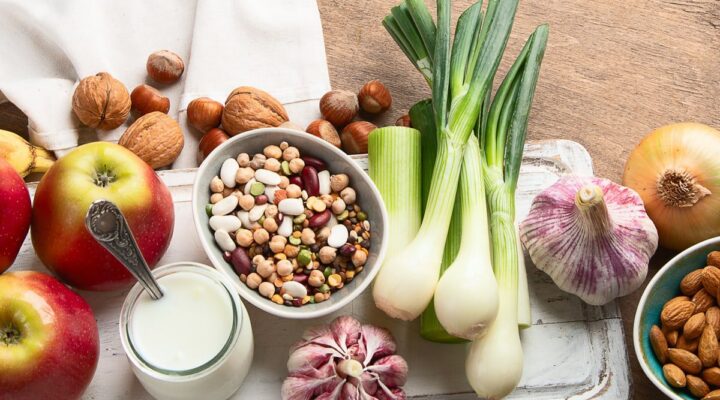
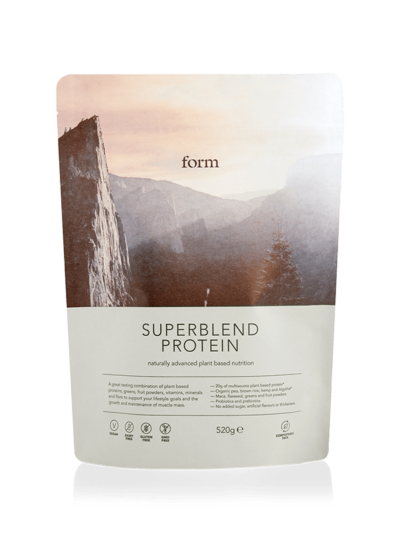
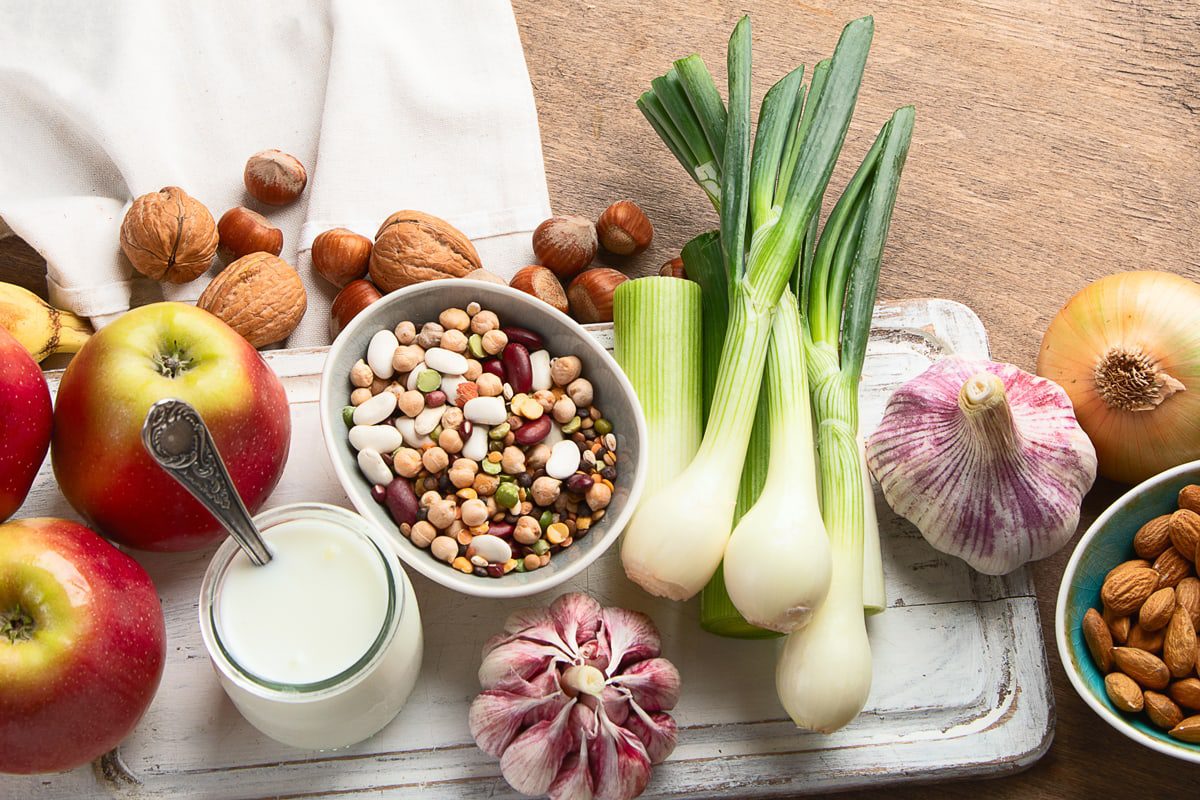
Prebiotics are equally important and often overlooked. The gut bacteria associated with positive mood outcomes need fibre to thrive: specifically, fermentable fibres found in garlic, onions, leeks, asparagus, oats, and legumes. Without adequate prebiotic substrate, even the most carefully chosen probiotic supplement has limited colonisation potential. This is why the concept of synbiotics, combining a defined probiotic strain with a compatible prebiotic, is showing stronger results in some trials than probiotics alone. Inulin, a fermentable prebiotic fibre with particular affinity for feeding Bifidobacterium species, is one of the more researched options; it appears naturally in chicory root and is also an ingredient in Form’s Superblend, making it a useful daily source alongside its protein and greens content.
Dietary variety matters here in a way that connects back to gut health more broadly: the 30 plant foods per week target that has emerged from microbiome research is as relevant to mood as it is to digestion. The two are, increasingly, understood as the same conversation.
The bottom line
Psychobiotics represent a genuinely emerging area of nutritional science, not a rebranding of basic probiotics with better marketing. The evidence for specific strains producing measurable effects on stress, anxiety, sleep quality, and mood is real, peer-reviewed, and growing. It is also incomplete, strain-specific, and more modest in healthy populations than the trend content implies.
What the science does support clearly is the broader dietary direction: more fermented foods, more prebiotic fibre, more diversity of plant sources, and less of the ultra-processed diet that is most consistently associated with gut dysbiosis and the mental health consequences that follow from it. That is not a pill. It is a pattern of eating. And it turns out, the gut has been trying to tell us that all along.