
Ask Dr Adam: Creatine for Women, What You Need to Know


For most of its history as a supplement, creatine has been marketed almost exclusively at men. The imagery was predictable: weights, bulk, performance. The science skewed the same way, with the majority of early research conducted on male participants. Small wonder, then, that many women have looked at creatine and concluded it probably wasn’t for them.
That narrative has been shifting. Women’s participation in strength training has risen sharply, and alongside it, a more serious conversation about whether creatine’s benefits extend beyond building bigger muscles, and whether women might actually have more to gain from supplementing than has previously been acknowledged.
We asked Dr Adam to assess the evidence honestly, including where it is solid, where it is speculative, and what it means in practice.
Should women take creatine differently from men?
The goal of creatine supplementation is the same regardless of sex: to increase the muscle’s creatine stores over time. The standard approach involves a loading phase (typically 20g per day for five to seven days, split across multiple doses to reduce gastric discomfort) followed by a maintenance dose of three to five grams per day.
There is some suggestion that the loading phase could be timed to the luteal phase of the menstrual cycle, since this phase involves a similar fluid shift into muscle cells as creatine loading does (6). Aligning the two may make loading marginally more effective. But Dr Adam is measured on this. “The whole point of supplementing creatine is to accumulate and maintain higher levels in the muscle over the long term. Outside of loading, that means taking a daily dose across several weeks, which spans multiple cycle phases. I wouldn’t overthink the timing.”
Women may also have good reason to skip the loading phase altogether. Higher doses are more likely to cause gastric discomfort, and loading typically produces a one to two kilogram fluid-related weight gain, though slightly less in women than in men. “If that is not something you want, you can achieve the same result with a steady three to five grams per day over four weeks. The end point is comparable,” says Dr Adam.
On dose, women naturally carry around 20% less creatine than men, largely due to differences in body composition rather than any deficiency (3). Some researchers have therefore proposed weight-based dosing: up to 0.3g per kilogram per day during loading and 0.05g per kilogram per day for maintenance. For a 55kg woman that would be approximately 16.5g during loading and 3g per day thereafter. That said, standard doses of 5g per day remain well-tolerated and effective (2).
Do women get the same performance benefits?
Despite the male-centric history of creatine research, the evidence that does include women points consistently in the same direction. Improvements in strength, power and exercise recovery have been demonstrated across studies in female participants (4), and where direct comparisons between men and women have been made, the performance benefits are broadly comparable (10).
Body composition outcomes may differ slightly. Men tend to see larger gains in fat-free mass following creatine supplementation, which Dr Adam attributes largely to biological differences rather than the supplement behaving differently. “Men have more type II fast-twitch muscle, which is where creatine is most active. Women rely more on type I muscle, which is more energy-efficient but less responsive to creatine-driven hypertrophy (3). That accounts for some of the difference in body composition outcomes, but it does not diminish the performance benefits women experience.”
What about the menstrual cycle?
This is where the science becomes more contested, and Dr Adam thinks it is worth unpacking carefully. A lot of the argument for hormonal influence on creatine metabolism rests on measurements of creatine kinase (CK) in the blood, which does fluctuate across the menstrual cycle. The problem is that blood CK is a marker of muscle damage or stress, not of creatine status in the muscle itself.
“There is no solid human evidence that sex hormones or menstrual cycle phases alter creatine synthesis, phosphocreatine stores, or the response to supplementation,” he says. “The mechanistic speculation largely comes from animal and cell models. It is interesting, but it does not translate directly to practical guidance.” His conclusion: no need to adjust daily maintenance dosing around the cycle.
What about fertility and pregnancy?
Creatine and fertility is an area where the evidence is preliminary but not without interest. Reproductive tissues, including oocytes and the uterus, are energy-demanding, and CK activity is high in these tissues in animal models. There is also an association in population data between higher dietary creatine intake and more regular menstrual cycles, based on US NHANES data (8). “But an association is not causation,” Dr Adam is careful to note. “There are no randomised controlled trials yet on creatine and fertility. The optimistic reading is that it won’t hinder and might help. There is no evidence of harm.”
Pregnancy is a more developed area of discussion. The placenta is a high-energy tissue with all the machinery for creatine transport and synthesis, and it relies on creatine to help regulate ATP supply to the foetus, particularly during periods of low oxygen. Associations between low dietary creatine intake and adverse pregnancy outcomes, including low birth weight, have been reported (1), but association is not causation.
Notably, the body adapts during pregnancy: creatine loss via urine decreases and internal synthesis increases, suggesting the body is actively conserving creatine to meet the fetus’s energy demands (9). “That tells you something about how important creatine is during pregnancy,” says Dr Adam. “But whether supplementing on top of those natural adaptations improves outcomes is still unclear. What we can say is that supplementation appears safe during pregnancy.”
What about menopause and older age?
This is arguably where the case for creatine in women becomes most compelling. Menopause is associated with meaningful losses in muscle mass, strength and training response, shifts in body fat distribution, and accelerated loss of bone density. Several of these changes are precisely the ones creatine is well-evidenced to address.
“Creatine supports maintenance and possible increase of muscle mass when combined with adequate protein and physical activity,” explains Dr Adam. “It enhances power output, which allows for more effective training and a better training response. And it is associated with better bone health, not by acting on bone directly, but by supporting more weight-bearing exercise.” These benefits overlap considerably with what the evidence shows in older adults more broadly, regardless of sex (2).
Cognitive aspects are also worth noting. Ageing is associated with decreased mitochondrial efficiency and increased cognitive fatigue, both of which are linked to creatine’s biological function in the brain. Some researchers have proposed that women may have distinct needs here due to differences in creatine kinetics in brain tissue (5) (7), though this remains at best, an emerging area of research.
The bottom line
The evidence for creatine in women is not as extensive as in men, but it points clearly in the same direction. Performance benefits are real and comparable. The specific life stages where women may gain the most, menopause and older age, are well-supported. And the areas where evidence is still emerging, fertility and pregnancy, suggest no reason for concern.
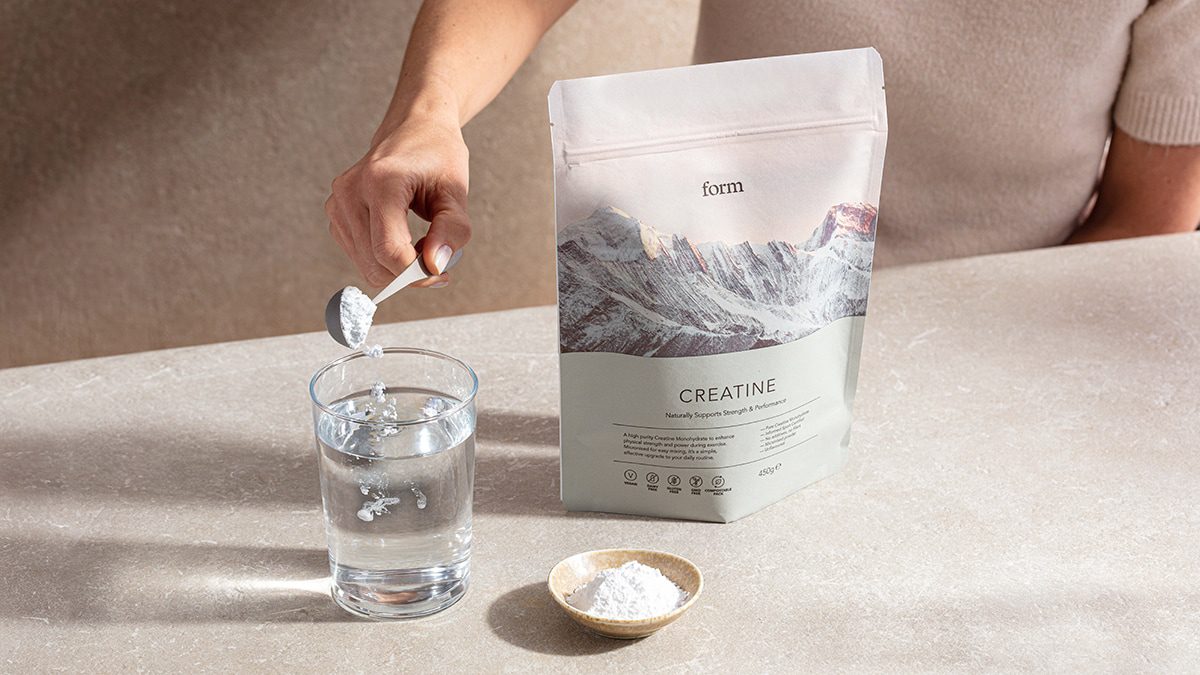
“Women can benefit from creatine as much as men,” says Dr Adam. “And there are aspects of women’s health across the lifespan where it may be especially relevant. My advice would be not to let the history of how creatine has been marketed put you off something that the evidence supports.” A daily 3–5g dose, added to a post-workout shake or stirred into water, is a straightforward place to start.