
Why Your Next Retreat Should Be by the Sea: The Quiet Science of Blue Therapy

There’s a moment, every time I land somewhere with the ocean in view, when my heart feels at ease and my mind settles down. I haven’t done anything. I haven’t meditated, I haven’t unpacked. I’ve just looked at the water.
For a long time I thought this was personal, a Brazilian thing, a childhood memory, the nostalgia of growing up with the sea as my playground. It turns out it’s also a measurable thing, and even if you’re not a beach baby like me, you can experience the same.
Marine biologist Dr Wallace J. Nichols spent years compiling the neuroscience behind it and gave it a name: Blue Mind. His 2014 book of the same name pulled together research suggesting that being near, in, on or under water shifts us into a mildly meditative state, slowing the breath, calming the nervous system, and reliably triggering creativity and a sense of awe.
We’ve borrowed his term loosely as blue therapy, the felt sense of restoration that comes from blue water and blue sky doing something to us we can’t quite engineer indoors.
What the science suggests
The evidence sits in three overlapping places.
The first, and strongest, is water itself. A 2017 systematic review of 35 studies published in the International Journal of Hygiene and Environmental Health found consistent positive associations between time spent around outdoor blue spaces (seas, rivers, lakes) and both mental wellbeing and physical activity. A later systematic review in Health Promotion International (2020), looking specifically at “blue care” interventions, found that mental health, particularly psycho-social wellbeing, improved with structured time in blue spaces. The mechanisms aren’t fully mapped, but the direction of travel is clear: water environments don’t just feel restorative, they measurably are.
The second, smaller body of work is on the colour blue itself. A pilot study at the Medical University of Graz found that ten minutes of blue-light exposure produced significant decreases in heart rate, heart-rate variability, and self-reported stress. A 2017 study published in PLOS ONE found that blue lighting accelerated post-stress relaxation compared with white. The colour-only evidence is honestly modest, these are small samples, but it tilts in the same direction as the water research.
And then there’s awe. Dacher Keltner at UC Berkeley has spent two decades studying it, and his work consistently shows that experiences of vastness, a horizon line, an enormous sky, the ocean, quiet the default-mode network, reduce stress, and produce what his research group calls the “small self“: a softening of self-focus that’s strongly associated with wellbeing and connection. Few stimuli on earth offer vastness as reliably as the sea.
If you’ve ever come back from a coastal walk feeling like a problem you couldn’t solve at your desk has somehow rearranged itself in your head, that’s blue mind doing its quiet, yet powerful work.
Why a coastline isn’t a luxury, it’s a necessity
I’ve written before about the productivity myth and the cost of being always-on. Resilience requires energy, and resting is how we recharge. As the science shows (and as you probably already knew intuitively), water nourishes the blue mind. Salt air charges us, the rhythm of waves regulates our nervous system, and the long horizon line gives us space, all three things we almost never get in a non-coastal city. We feel safe, and the body and spirit have a chance to repair.
This is why a retreat by the sea is structurally different from a retreat in a forest or a city wellness weekend. Both are valuable. But the ocean offers something distinct, a soft, unbroken focal point that quiets the mind without demanding anything of it.
And then there’s Trancoso
If you’re going to commit to a week of blue therapy, you may as well do it somewhere the environment and energy have been doing this work for centuries.
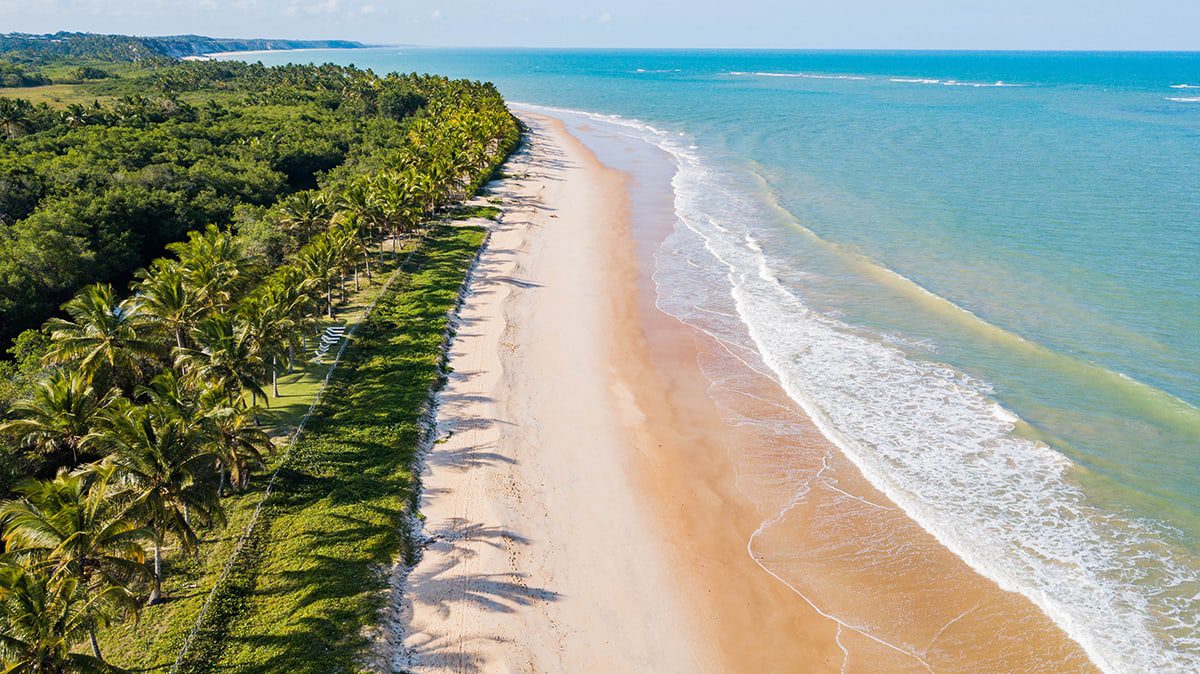
Trancoso sits on the southern coast of Bahia, a former 16th-century Jesuit fishing village that the rest of the world only really discovered in the 1970s, when Brazilian artists and free spirits found their way down the dirt roads and decided to stay. Its heart is the Quadrado, a long grassy square lined with brightly painted colonial houses and a small white church looking out toward the Atlantic, all UNESCO-protected. By day it’s barefoot and quiet. By night it’s lit by candlelight and lanterns hanging from the trees, with the sound of guitars drifting out of the bars.
What makes Trancoso particular is the balance it’s somehow held. There is luxury here, Trancoso is one of Brazil’s most coveted barefoot destinations, but it sits alongside fishermen, capoeira on the green, locals selling coconut water under the trees, and beaches that still feel like the Portuguese sailors found them. Praia do Espelho, half an hour away, is regularly named one of the most beautiful beaches in Brazil; at low tide the reef forms warm natural swimming pools you can lie in for hours.
It is, in the most literal sense, a place built around blue, and filled with the gentle warmth of its locals.
Casa Mandacaru: the retreat
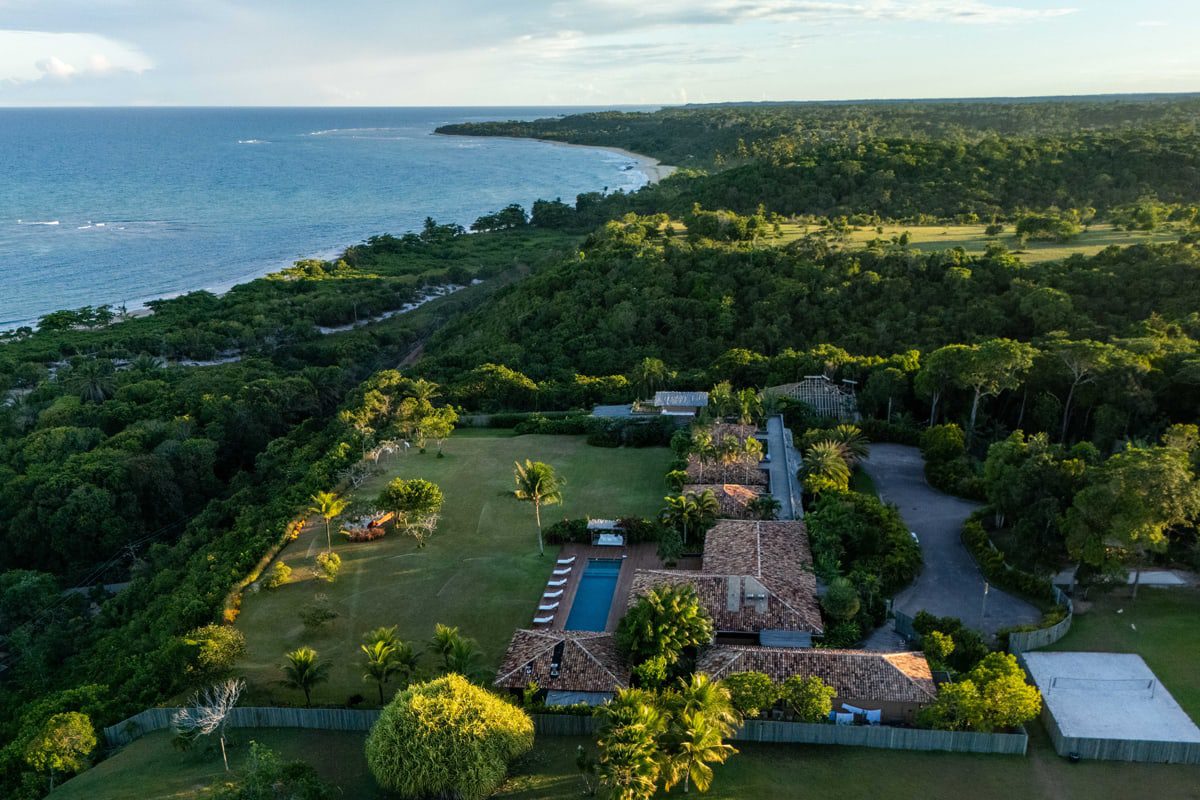
This January and February I’ll be facilitating mindfulness workshops at The Emma Henry Retreats at Casa Mandacaru, a luxury sanctuary perched above the Trancoso coastline with uninterrupted ocean views, eight suites, an organic farm-to-table kitchen, and a purpose-built shala overlooking the sea. It’s truly a dream, a magical place where you feel at home and immediately at ease.
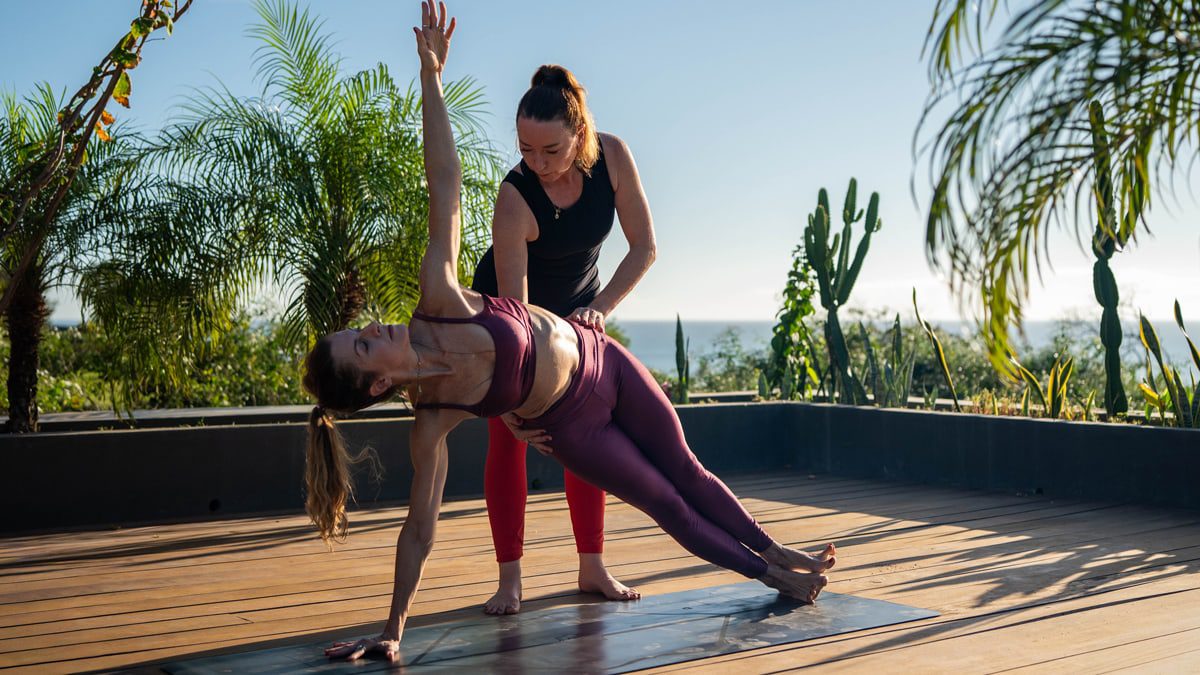
Each day opens with Emma’s dynamic, music-led Jivamukti yoga. Emma is the only teacher in the UK facilitating Jivamukti Teacher Trainings, and I’ve been religiously taking her classes since 2022, about two or three times a week. I can sincerely say that every single class is unique, special and fun. She’s a genius Yogini, her sequences are creative and her music spot on.
The day closes with a restorative yin practice at sunset. Alongside the yoga, I’ll be weaving in mindfulness drawn from Tibetan Buddhist tradition and grounded in the science I’ve been studying through my Master’s in Neuroscience & Psychology of Mental Health. Between practices, the days are unhurried: spa treatments in the privacy of the villa, beach time, kayaking, ocean swims, and long table dinners by chef Kelvin Saraiva.
Two dates are available: 19–26 January 2027 and 1–8 February 2027.
If you’ve been quietly wondering where to go to actually rest and reset, not just change scenery, this is the invitation. Come for an adventure that moves from sunrise practice to samba, from ocean swims to a blessing ceremony around the fire. Let the water, yoga and meditation do what they have always quietly known how to do: deeply restore and energise you.
You can find more information at mandacaruvillaretreat.com.
Sources
- Nichols, W. J. (2014). Blue Mind: The Surprising Science That Shows How Being Near, In, On, or Under Water Can Make You Happier, Healthier, More Connected, and Better at What You Do. Little, Brown. — bluemind.org
- Gascon, M., et al. (2017). Outdoor blue spaces, human health and well-being: A systematic review of quantitative studies. International Journal of Hygiene and Environmental Health, 220(8), 1207–1221. — PubMed
- Britton, E., Kindermann, G., Domegan, C., & Carlin, C. (2020). Blue care: a systematic review of blue space interventions for health and wellbeing. Health Promotion International, 35(1), 50–69. — PMC
- Litscher, D., et al. (2013). The influence of new colored light stimulation methods on heart rate variability, temperature, and well-being: Results of a pilot study in humans. Evidence-Based Complementary and Alternative Medicine. — PMC
- Minguillon, J., et al. (2017). Blue lighting accelerates post-stress relaxation: Results of a preliminary study. PLOS ONE, 12(10). — PMC
- Monroy, M., & Keltner, D. (2023). Awe as a Pathway to Mental and Physical Health. Perspectives on Psychological Science, 18(2), 309–320. — PMC
- Piff, P. K., Dietze, P., Feinberg, M., Stancato, D. M., & Keltner, D. (2015). Awe, the small self, and prosocial behavior. Journal of Personality and Social Psychology, 108(6), 883–899. — PubMed